
Until We Reckon: Violence, Mass Incarceration, and a Road to Repair
A restorative-justice practitioner's case for addressing violence without relying on prison. (Listed as required NEG reading in the workbook's tournament checklist.)
The Justice Workbook Reading List
Every book recommended in the workbook, organized by theme. The list spans a deliberate range of perspectives — from rehabilitative and restorative to retributive and conservative — so students can argue both sides honestly. Each title links to Amazon.
New: “Read & Respond” Discussion Guides
Printable comprehension & discussion questions for Just Mercy, Until We Reckon, and The New Jim Crow — all three in one PDF for $12.99. Get the bundle → (free with any bulk order by Sept 15).
A restorative-justice practitioner's case for addressing violence without relying on prison. (Listed as required NEG reading in the workbook's tournament checklist.)

Argues that mass incarceration operates as a contemporary system of racial control.

A concise abolitionist argument questioning the prison as a social institution.

A lawyer's account of defending the condemned, and a moving case for mercy in the justice system.

A classical-liberal essay on justice, law, and the proper limits of the state.

A landmark history of how modern punishment shifted from the body to surveillance and the soul.

The classic novel of guilt, conscience, and redemption — a profound literary exploration of what punishment does to the soul.

A retributivist's argument that the worst crimes deserve proportionate punishment.

An award-winning investigation of why crime and democracy intertwine in the world's largest democracy — a striking comparative lens on money, muscle, and power in politics.

A 1990s conservative argument linking "moral poverty" to violent crime.

Pulitzer Prize-winning study of how a generation of Black leaders confronted crime in their own communities — a nuanced look at tough-on-crime policy and its costs.
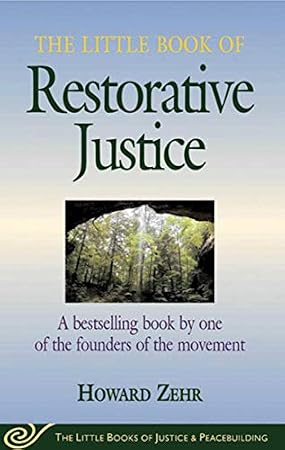
The standard short introduction to restorative justice from the field's founding voice.

The foundational text reframing crime as harm to people and relationships rather than to the state.

Restorative-justice principles applied to racial harm and reconciliation.

An investigation of domestic violence and the systems that fail its victims.

A practical guide to victims' rights and how to navigate the justice process. (Workbook lists the author as Mary Achilles; the published author is Mary L. Boland.)

Argues that prosecutorial discretion, not drug laws, is the real driver of mass incarceration.

A critique arguing that many "reforms" simply extend carceral control by other means.

On the two Americas of policing and justice, and how order and law come apart.

Data-driven analysis of the great crime decline and what it took to sustain it.

Argues that the criminal justice system reflects and reinforces class inequality.

Pulitzer Prize-winning history of forced labor and convict leasing after emancipation.

Traces how crime statistics shaped ideas of race in American cities.

A Christian argument against the death penalty rooted in grace and the gospel.

A Christian vision for biblical justice and doing good in the world.

Thirty-eight lessons on recognizing bad reasoning — a homeschool favorite for sharpening the logic every debater needs.
The workbook also points students to free online essays and primary sources — from the Stanford Encyclopedia of Philosophy to the Code of Hammurabi — collected in its Free Online Resources appendix.
Get the WorkbookA note on links: As an Amazon Associate, this site earns from qualifying purchases. Each title links to Amazon with the affiliate tag greenwoodwalk-20. This is not an exhaustive list of every source in the workbook — the book also cites many free online essays, encyclopedia entries, and reports.
Get the Workbook
Nearly 500 pages of guided study for the 2026-2027 NCFCA Lincoln-Douglas resolution. Available in print on Amazon, or as an instant PDF download.